


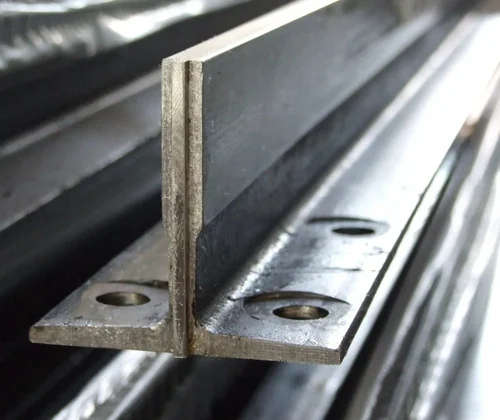

CFG Is Leading Elevator Guide Rails Supplier In Pune, Trader, Wholesaler & Distributor Of T-Section MS Lift Guide Rails. CFG Components is a supplier of elevator guide rails based in Pune and provides elevator guide rails which are designed to ensure smooth, stable and reliable vertical movement for both the elevator cabins and the counterweights. Since guide rails are an important component of an elevator system, they assist in keeping the cabin and the counterweight in proper movement along a fixed vertical path.
The elevator guide rails produced by CFG Components are made from durable mild steel and are designed to give accurate guidance while at the same time helping to reduce unnecessary vibration when the elevator is in operation; their T-section shape makes them appropriate for use in elevator situations in which stable and controlled movement is required.
What Are Elevator Guide Rails?
The vertical structural members known as elevator guide rails are fitted inside the elevator shaft in order to guide the movement of the elevator cabin and the counterweight; they offer a fixed route along which both the cabin and the counterweight move as the elevator goes between various floors.
The guide rails serve to keep the elevator shaft aligned when the cabin is moving upwards or downwards and they aid in ensuring stable operation by helping to control any unwanted lateral movement and vibration. Guide rails which have been properly chosen and installed thus make up a significant part of the elevator's entire mechanical system.
Why Should You Choose Elevator Guide Rails?
It is important to select appropriate guide rails if the elevator is to move smoothly and be properly controlled; the rails must provide accurate guidance and at the same time meet the system's continuous operational requirements.
The elevator guide rails produced by CFG Components are made from mild steel so that they will be strong and durable for regular elevator use, and the T-section shape is specifically designed for use as an elevator guide to give the cabin and the counterweight a uniform guiding surface.
Applications of Elevator Guide Rails
Salient Features of Elevator Guide Rails
1. Precision Engineered
The guide rails for the elevator are intended to ensure accurate guidance for both the elevator cabins and the counterweights, and good guidance is necessary for maintaining controlled vertical movement.
2. Mild Steel Construction
The guide rails are made from mild steel since this material is suitable for use in elevators and for repeated operation.
3. T-Section Profile
The T-section shape is designed for use with elevator guide rails and ensures that the required form of the rail is obtained for guiding the elevator components.
4. Multiple Thickness Options
The guide rails come in 5mm, 9mm and 16mm thicknesses so that you can choose the appropriate one according to the needs of the elevator system.
5. Colour-Coated Finish
The rails have a finish that is coloured, giving the product a finished surface which is suitable for use in appropriate elevator installations.
6. High Load Capacity
The guide rails are constructed so as to endure the loads occurring during the continuous operation of the elevator, thus ensuring reliable guidance of both the cabins and the counterweights.
7. Reduced Vibration
Building guide rails correctly keeps movement steady and can cut down on needless shaking during elevator use.
8. Long Service Life
Because it has been properly installed and kept in good condition, the strong build of the guide rails ensures long-term use and decreases the requirement for frequent maintenance.
Benefits of Elevator Guide Rails
Elevator Guide Rails Trading In Pune
CFG Components takes part in the trading of elevator guide rails in Pune, providing guide rails to elevator contractors, installers, dealers, and all other customers who are engaged in elevator projects. The guide rails are made from mild steel and come in a T-section profile with thicknesses of 5mm, 9mm and 16mm.
The guide rails are designed for use in cases where steady movement of the cabin and the counterweight is needed, and their precision engineering, solid material, and colour-coated finish mean that they can be used in various types of elevator installation depending on the technical requirements.
Elevator Guide Rails Wholesale In Pune
CFG Components also sells Elevator Guide Rails Wholesale In Pune for customers who need guide rails in larger amounts for elevator installations, projects, and regular supply needs.
Elevator contractors, dealers, installers and companies working on several elevator projects can find wholesale supply to be useful. Since there are various thickness options available, customers are able to choose guide rails suitable to the requirements of their individual elevator systems.